

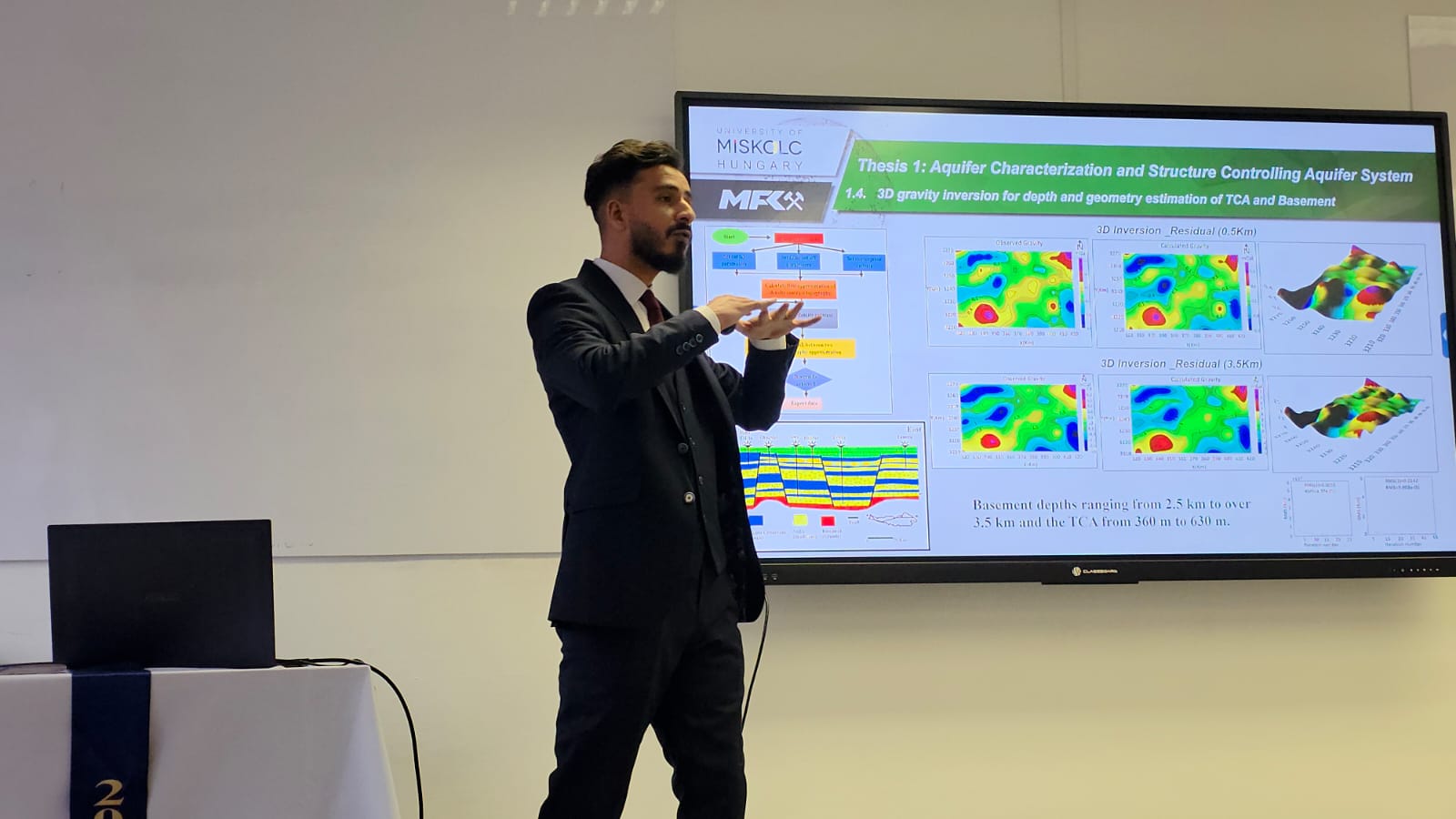
A new research article published in highly ranked D1 journal “Geoscience Frontiers” demonstrates how advanced machine learning and geophysical techniques can revolutionize our understanding of groundwater systems in arid environments. The study, titled “Aquifer characterization and salinization origin using unsupervised machine learning and 3D gravity inversion modeling, Siwa Oasis, Egypt,” was conducted by Dr. Mohamed Hamdy Eid under the supervision of Prof. Dr. Peter Szucs and Dr. Attila Kovacs from the Institute of Water Resources and Environmental Management at the University of Miskolc.
Siwa Oasis, located in Egypt’s northwestern Western Desert, faces critical water management challenges due to its arid climate and complete dependence on groundwater resources. The oasis is home to approximately 23,000 people and extensive agricultural activities, yet groundwater salinization poses a significant threat to sustainability. The research addresses this challenge through an innovative integrated approach that combines unsupervised machine learning techniques with advanced gravity data analysis.
A critical finding of the research is the spatial relationship between groundwater salinity and structural complexity. The southern part of Siwa Oasis, characterized by reduced structural complexity, exhibits lower groundwater salinity and has been identified as the optimal area for fresh groundwater extraction. Conversely, central and northeastern regions show higher salinity zones that spatially correlate with gravity-derived structural systems, suggesting that fracture networks may facilitate leakage from hypersaline surface lakes into underlying aquifer systems.
This integrated approach represents a significant methodological advance for sustainable groundwater management in structurally complex arid environments. By combining the detailed lithological information from well logs with the spatial coverage of gravity surveys, the research provides a comprehensive three-dimensional understanding of aquifer geometry and the structural controls on groundwater flow and quality. The findings have direct implications for water resource planning and management strategies in Siwa Oasis and similar arid regions worldwide.
Tovább a cikkhez: sciencedirect.com