
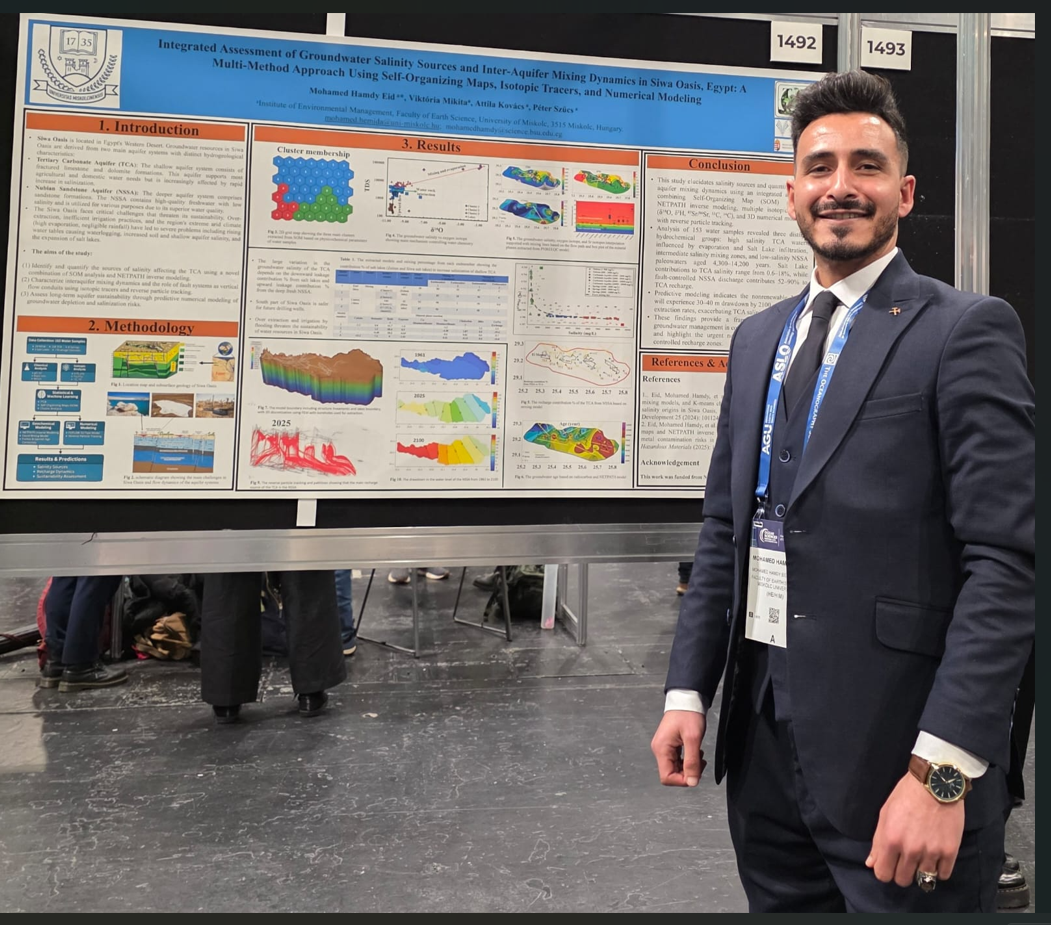
Led by Dr. Mohamed Hamdy Eid and Professor Peter Szucs from the Institute of Water Resources and Environmental Management at the University of Miskolc, the research introduces a novel integrated methodology that combines machine learning, environmental isotope tracers, inverse geochemical modeling, and three-dimensional groundwater flow simulation. For the first time, self-organizing maps (SOM), an unsupervised machine learning technique, were integrated with isotopic analyses, NETPATH inverse modeling, and FEFLOW numerical simulations to identify groundwater salinity sources, quantify mixing between deep and shallow aquifers, and predict the long-term impacts of groundwater abstraction.The study revealed that groundwater salinity in the shallow aquifer is primarily driven by leakage from hypersaline lakes, while deep fossil groundwater from the Nubian Sandstone Aquifer reaches the shallow aquifer through geological fault systems, providing an essential source of freshwater recharge. The research also predicts that continued groundwater extraction under current conditions could lower groundwater levels in the deep aquifer by 30–40 meters by the end of this century, increasing the risk of salinization and threatening the long-term sustainability of water resources in the oasis.
Beyond its scientific contribution, the research provides practical guidance for water-resource managers and policymakers by identifying priority zones for groundwater protection and supporting evidence-based strategies to preserve freshwater resources for agriculture, ecosystems, and local communities. The proposed multi-method framework is transferable to arid and semi-arid regions worldwide, demonstrating how advanced data analysis and hydrogeological modeling can help address critical water-security challenges under increasing climate and human pressures.
Tovább a cikkhez: Hydrogeology Journal