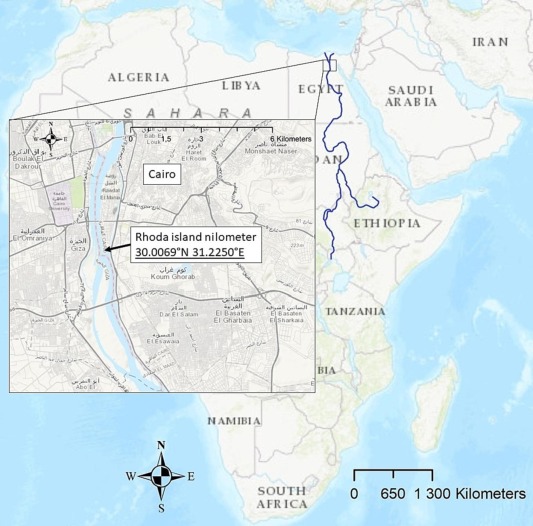
Geophysicists and hydrogeologists from Miskolc and Sopron gave climate researchers a unique tool by mathematically supplementing the gaps in the Nile water level measurements – the very first surviving and uniquely long numerical observation.
The lack of water level measurement covering thirteen centuries (measured from 622 to 1921) has hindered long-term data analysis until now. The longest continuous data series covered “only” 845 years. This study bridges the gaps with the help of a correct mathematical procedure, transforming the annual water level data of the Nile into a single, now uniformly manageable 1300-year time series.

Spectral analysis revealed various periods. The existence of an appr. 400-year period is seen, too. With this, and by sectioning the entire time series into characteristic stages, the study provides climate researchers with a unique and unbiased basis for searching for the causes of the Nile water level changes that have occurred, since there is no comparable quantitative time series in terms of duration, accuracy and awareness.
The study was published in a D1 journal. (Szűcs P, Dobróka M, Turai E, Szarka L, Ilyés Cs, Hamdy E M, Szabó N P, 2024: Journal of Hydrology, 630, 130693, https://www.sciencedirect.com/science/article/pii/S0022169424000878) .
The University of Miskolc’s method is also suitable for predicting future events in other catchment areas.
Contact: Csaba Ilyés, csaba.ilyes@uni-miskolc.hu





 The starting point of the study is that, even though the discourse related to the revitalization of brownfield areas has a long history in Hungarian development policy practice, its role in promoting the circular economy and environmental sustainability has appeared with little emphasis in Hungary so far, for which the article presents a few theoretical and practical arguments. In the study, the authors introduce a framework presenting the environmental, social and economic benefits of brownfield areas’ redevelopment, highlighting sustainability benefits along concrete examples.